ABB SF810INT-LOS-UVIR-T-L Dual-Spectrum UVIR Flame Scanner: Complete Technical Guide
Introduction
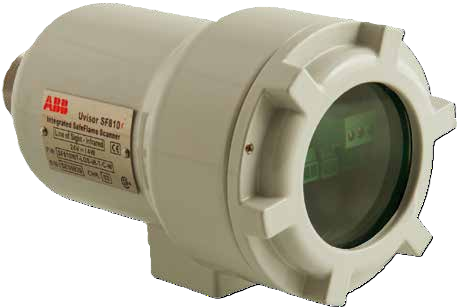

Designed for utility and industrial boilers—including wall-fired, corner-fired, down-shot, and cyclone burner configurations—the SF810INT-LOS-UVIR-T-L provides absolutely reliable flame presence/absence information while continuously monitoring flame quality to deliver additional operating intelligence to plant personnel.
Model Number Breakdown
Understanding the ABB nomenclature is essential for proper specification:
| Suffix | Meaning |
|---|---|
| SF810INT | Integrated design—sensor, processor, and output relays in one housing |
| LOS | Line-of-Sight optical system for direct flame viewing through wind boxes |
| UVIR | Dual-spectrum sensor: UV (SiC @ 280nm) + IR (Si @ 920nm) |
| T | Terminal connection version with screw-type removable connectors |
| L | Local configuration interface with 3-digit LED display and 4 pushbuttons |
The UVIR designation is the defining feature of this model. Unlike single-spectrum scanners (UV-only or IR-only), the UVIR version incorporates both a SiC photodiode with spectral response peak at 280nm for ultraviolet detection and a Si photodiode with spectral response peak at 920nm for infrared detection. These signals can be processed individually or combined, depending on burner operation requirements.
The T-L suffix indicates the terminal-equipped version with removable screw-type connectors (T) and a local display and configuration interface (L)—a 3-digit LED display with four pushbuttons (UP, DOWN, LEFT, RIGHT) for on-site parameter adjustment and real-time status monitoring.
UVIR Dual-Spectrum Technology: Why It Matters
The Science Behind Dual Detection
Combustion flames emit radiation across a broad spectrum. Different fuels and combustion conditions produce distinct spectral signatures:
UV (Ultraviolet) detection (190–270nm) captures the ionization radiation produced during combustion, providing fast response to flame ignition and extinction. UV sensors are particularly effective for gas-fired burners where high-energy UV emissions are prominent.
IR (Infrared) detection (4.3μm CO₂ band, plus Si photodiode response @ 920nm) verifies combustion through CO₂ emission signatures and thermal radiation. IR sensing excels with heavy fuels like oil, pulverized coal, and Orimulsion.
Superior False Alarm Rejection
The dual-spectrum approach fundamentally improves reliability over single-sensor systems:
UV-only scanners can be triggered by lightning, welding arcs, or other UV sources
IR-only scanners can be fooled by hot refractory walls, steam, or background thermal radiation
UVIR dual-spectrum requires both UV and IR signatures to confirm flame presence—significantly reducing nuisance trips while maintaining safety integrity
This makes the SF810INT-LOS-UVIR-T-L particularly valuable in environments with high background radiation, steam interference, or refractory glow that would trigger false alarms in single-sensor systems. The scanner analyzes flame flicker frequency and intensity patterns to distinguish genuine combustion from all forms of background radiation.
Multi-Fuel Versatility
The UVIR configuration supports the broadest range of fuels of any scanner in the SF810i series:
This multi-fuel capability makes the SF810INT-LOS-UVIR-T-L ideal for facilities that frequently switch between fuel types—such as power plants with dual-fuel burners, refineries processing varying feedstocks, or waste-to-energy facilities with variable fuel compositions.
Key Technical Specifications
Integrated Architecture
Traditional flame detection systems required separate scanners and external analysis units. The SF810INT eliminates this complexity by embedding all signal processing electronics—including ABB‘s advanced flame analysis algorithms—directly inside the probe housing.
This integrated design delivers several critical advantages:
Direct 4–20 mA and relay outputs to PLC, DCS, or Burner Management Systems (BMS)
Reduced cabling costs and simplified system architecture
Minimized signal degradation over long distances
Elimination of external processors (no FAU810 or similar units required)
Lower overall system cost and reduced panel space requirements
The scanner‘s self-diagnostic capabilities continuously report optical contamination, sensor degradation, and wiring faults to the control system, enabling predictive maintenance scheduling.
Applications
The SF810INT-LOS-UVIR-T-L is deployed across multiple demanding industrial sectors:
Power Generation
Utility and industrial boilers with wall-fired, corner-fired, down-shot, and cyclone burner configurations. The dual-spectrum design excels in coal-fired plants where high background radiation from refractory walls can confuse single-sensor systems.
Petrochemical & Refining
Process heater safety in refineries, where hydrocarbon flames require reliable detection despite varying fuel compositions and high ambient temperatures. The line-of-sight optics penetrate flame flicker and turbulence to maintain stable signals during load changes or fuel switching operations.
Waste-to-Energy
Rapid flame-out response for variable-fuel incineration systems. The UVIR scanner‘s ability to discriminate between actual combustion and hot refractory surfaces reduces nuisance trips while maintaining safety integrity.
Cement & Metallurgical
Cement kilns, metallurgical furnaces, and alkali recovery boilers benefit from the scanner‘s ability to detect flames across a wide temperature range (600°C to 1800°C).
Installation & Maintenance Considerations
Lens Cleaning Air Supply
Clean, dry instrument air must be supplied for continuous lens purging. For LOS (Line of Sight) versions, the recommended airflow is 115 l/min (4 SCFM). Environments with excessive contaminants may require flow rates up to 400 l/min (14 SCFM).
The minimum cleaning air pressure must be 20mm H₂O (1″ W.C.) above the maximum wind box pressure measured at the “Y” connection inlet.
This airflow serves two critical purposes:
Creates a positive pressure curtain preventing soot and particulate buildup on the optical window
Provides cooling for internal electronics in high-temperature environments
Alignment Optimization
For optimal performance, the probe axis should target the most stable region of the flame root—typically the ignition zone where the flame is most consistent. Proper line-of-sight alignment with the flame center is critical. During commissioning, the adjustable sighting tube allows precise flame targeting.
Critical alignment considerations:
Avoid adjacent flame interference (“flame stealing” or cross-talk)
Minimize background thermal radiation from refractory walls
Ensure no mechanical obstructions or reflective surfaces in the optical path
The scanner provides a 90° cone of vision for comprehensive flame coverage
Electrical Integration
The T-L terminal version provides straightforward field connections:
4–20 mA analog output (galvanically isolated, R_load ≤ 500Ω) for flame intensity monitoring
Flame relay (1 NO contact, 240 VAC/1.5A) for BMS safety interlock
Dual redundant RS-485 ports configurable for Modbus RTU (up to 115.2 kbit/s) or Profibus DP (up to 12 Mbit/s)
Two digital inputs (24 VDC, 5mA) for selecting from 4 different configuration parameter sets
Local Configuration & Diagnostics
The L suffix denotes the local interface package:
4 pushbuttons (UP, DOWN, LEFT, RIGHT) for on-site configuration
3-digit LED display for real-time flame intensity indication, status codes, and parameter feedback
Field-configurable parameters include:
Flame Failure Response Time (FFRT): 0.2–4.0s in 0.1s increments
Serial communication protocol selection (Modbus/Profibus)
Flame algorithm parameters
Analog output scaling
Maintenance Best Practices
During boiler overhauls, the probe should be removed and the optical window gently cleaned using anhydrous ethanol to maintain optical clarity. Regular inspection of the T-L screw terminals for tightness is recommended, as vibration can gradually loosen connections over time.
The scanner‘s self-diagnostics report:
Why Choose the SF810INT-LOS-UVIR-T-L?
True Dual-Spectrum Detection – UV + IR sensors provide the highest possible flame discrimination and false alarm rejection
Maximum Fuel Flexibility – Single scanner handles natural gas, oil, coal, and alternative fuels
Integrated Architecture – No external processors or amplifiers required
Harsh Environment Ready – ATEX II 2GD Ex d IIC T6 certified with IP66/IP67 protection
Field-Friendly Termination – T-L removable screw terminals plus local display simplify wiring, configuration, and maintenance
Seamless Integration – Direct PLC/DCS connectivity with Modbus/Profibus support
Proven Reliability – Backed by ABB‘s decades of combustion safety expertise
Conclusion
The ABB SF810INT-LOS-UVIR-T-L represents the pinnacle of industrial flame detection technology. By integrating dual UV/IR sensing, intelligent signal processing, and robust environmental protection into a single ATEX-certified housing with field-friendly terminal connectivity and local display, it delivers the reliability, flexibility, and performance that modern burner management systems demand.
The UVIR dual-spectrum configuration is particularly valuable for facilities that operate across multiple fuel types or in environments with challenging background radiation—making this scanner the optimal choice for power generation, petrochemical refining, waste-to-energy, and heavy industrial applications.
Whether for new greenfield installations or upgrading aging flame detection infrastructure, the SF810INT-LOS-UVIR-T-L provides a cost-effective path to enhanced combustion safety, operational efficiency, and regulatory compliance.